What does Jersey have that we don’t?


Jersey is already known in cycling circles as somewhat of a dream for sport cyclists and pootlers alike due to its mix of hills, quiet lanes and idyllic traffic-free routes. However, the Government of Jersey (GoJ) has big ambitions to get more islanders on bikes for everyday trips such as to work, school and the shops. Given the size of Jersey – only nine by five miles – most places are within reach by bike, particularly if you have an e-bike to combat the hills and the fierce headwinds along the coastal routes!
PJA were commissioned by the GoJ to help them develop a high-quality network of walking and cycling routes to enable islanders to choose to travel by active modes. The project is one of many “rapid plans” which form part of Jersey’s wider sustainable transport policy. This acknowledges that the Island’s transport system has very much evolved around the car, often at the expense of walking, cycling, and that a business-as-usual approach is no longer tenable if the Island’s carbon neutrality ambitions are to be achieved.
PJA was the lead author of the Department for Transport’s (DfT) guidance on producing Local Cycling and Walking Infrastructure Plans (LCWIPs) – which we’re currently refreshing to improve the guidance for rural areas – and Local Transport Note 1/20 on Cycle Infrastructure Design. We were therefore excited to apply our expertise to Jersey.
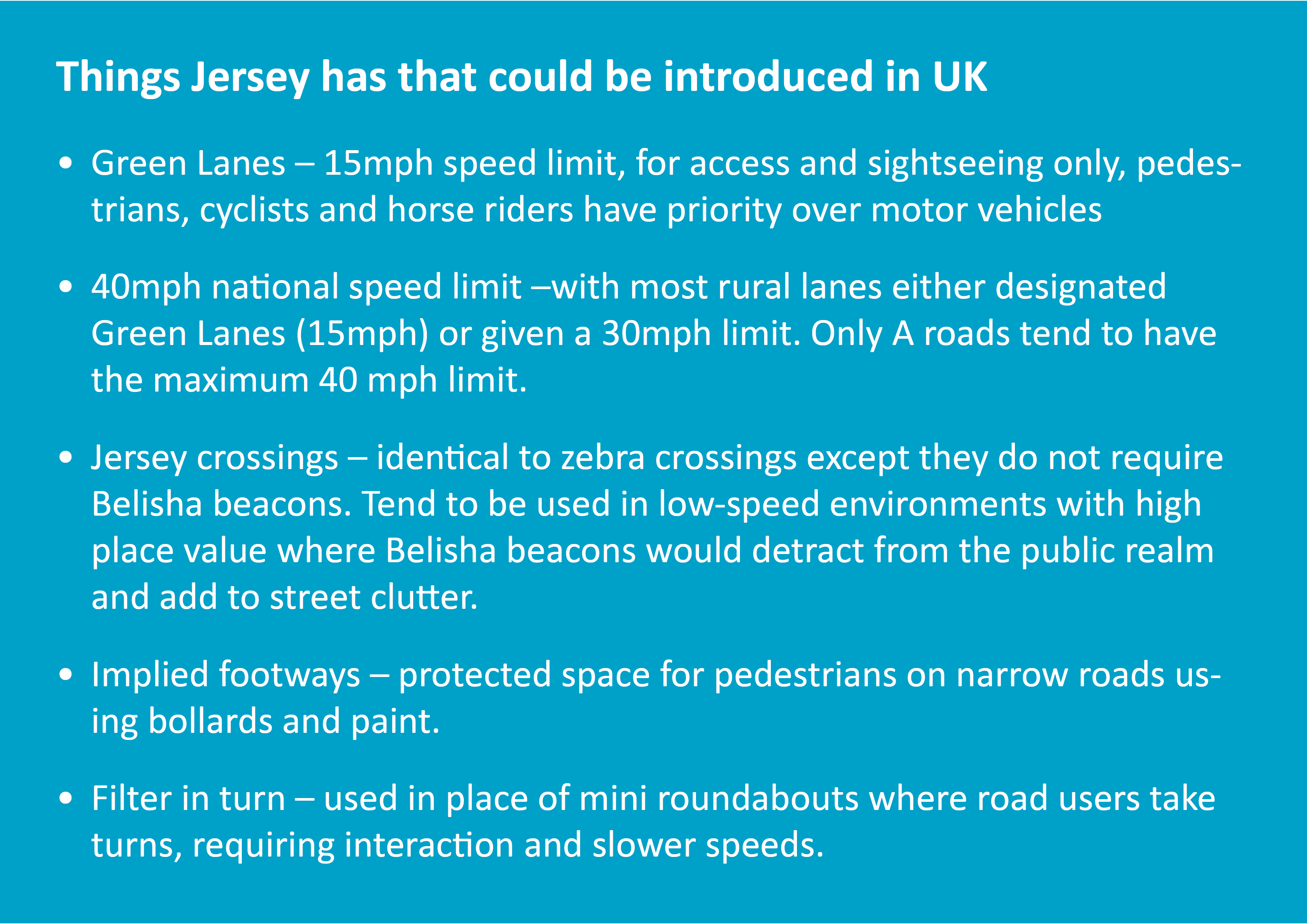
Jersey’s roads have a similar regulatory framework to England but differ in some interesting ways, including the use of Green Lanes, a 40mph national speed limit, and so-called ‘Jersey Crossings’. When we visited in June to audit the network, we took the opportunity to take a detailed look at some of the things they do differently and to consider what benefits they could have in the UK for modal shift and creating more sustainable places.
Green Lanes and 40mph National Speed Limit
The default speed on rural roads in the UK is 60mph, though it is rarely safe to travel at that speed except on well-engineered roads. Although many minor rural roads have low traffic flows, most have no footways or cycling infrastructure, meaning people walking and cycling must share narrow carriageways with fast traffic. Indeed, according to Brake, the road safety charity, rural roads, per mile travelled, are the most dangerous for all users. In 2015-2020, 56% of pedal cycle fatalities occurred on rural roads♦.
We know from our recent work producing LCWIPs for rural authorities such as West Northamptonshire and Mendip Council that there’s demand for safe walking and cycling infrastructure in rural areas but it’s currently very difficult to deliver, often relying on converting disused railway lines into cycleways or purchasing land to deliver cycle tracks behind hedges. As more peripheral and rural locations are relied on to meet housing need, paired with a need to meet net zero targets, we increasingly need rural roads to facilitate walking and cycling trips.
Jersey’s Green Lanes were introduced in 1994 and currently cover 67 miles of Jersey’s roads. On Green Lanes vehicle speeds are limited to 15mph and pedestrians, cyclists and horse riders have priority (through Jersey’s Highway Code) over motor vehicles. Currently two of Jersey’s 12 parishes have no Green Lanes but this is expected to change with a review of the network currently underway, informed by our study. Jersey’s national speed limit is also 40mph with many rural lanes outside of the Green Lane network signed at 30mph.
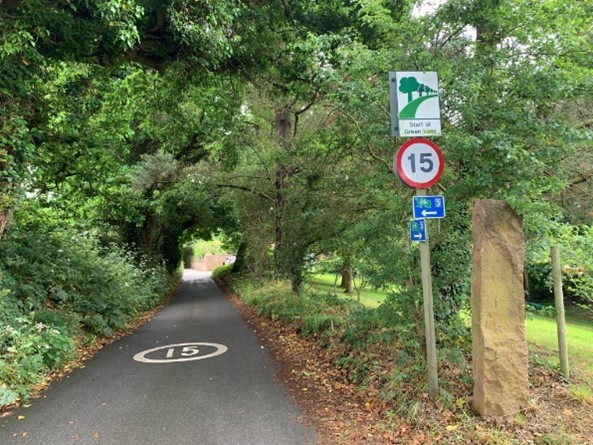
Green Lane Network
Similar legislation exists in England where local authorities can designate country lanes as Quiet Lanes under the Transport Act 2002. Inspired by Jersey’s Green Lanes, Quiet Lanes are minor rural roads which have been identified as important for people walking, cycling and horse riding. To qualify for Quiet Lane status, a lane should have less than 1000 vehicles per day and have 85th percentile speeds of less than 35mph. However, crucially, Quiet Lane designation is not supported with enforceable restrictions so, while many include speed limits (generally 30 or 40mph) and rural traffic calming, these are not a requirement.
Having clocked up many miles cycling the Green Lanes during our week-long visit, there is a clear difference between Green Lanes and Quiet Lanes with the former feeling far safer. Based on our observations, the narrow nature of the Green Lanes combined with the 15mph limit ensures that traffic is generally restricted to those who require access and the few drivers we did encounter drove courteously, only overtaking when we waved them past. This created a fairly idyllic cycling experience in stark contrast with our experience of similar roads in the UK.
Trialling reduced speed limits on England’s rural roads would be a quick win which is likely to improve road safety and enable more walking and cycling in rural areas with very little investment needed. Similar trials have already been successfully undertaken in Wales and the Scottish Borders.
Implied footways
Like many rural settlements in the UK, Jersey’s roads often have very narrow footways in order to ensure two way traffic can be accommodated. However, a widespread – and successful approach – taken in Jersey is that of ‘implied footways’ where protected space is provided – typically on one side of the road – using bollards and paint. While often below what we would typically consider minimum widths for footways, this approach is space efficient and cost-effective way of providing space for pedestrians.
The imped footways also have the benefit of reducing the remaining carriageway width meaning drivers had to slow down to around 10mph to pass each other safely, creating a calmed traffic environment. In some places, the carriageway width was reduced further, meaning drivers had to pull partially into the implied footway to pass. This was facilitated by the placement of bollards between the implied footway and carriageway, which were placed sufficiently close together to demarcate a clear line between implied footway and carriageway, but sufficiently far apart to allow drivers to pass into the footway space when needing to pass a car in the other direction. This created an effective give-and-take environment in which drivers passed into pedestrian space with due care, and safety was drastically improved for pedestrians in otherwise contested spaces.
A common mistake with such an approach is to ‘over-urbanise’ rural roads through use of highways related infrastructure such as traffic wands and white lines/hatching. Jersey’s approach responded effectively to the rural environment through use of natural coloured surfacing materials and use of natural materials such as wood for the bollards, which embedded a sense of local identity and place by bearing parish or Jersey Government emblems. The overall result was an attractive and effective creation of pedestrian priority in typically contested locations.
No doubt there’s isolated examples of implied footways in the UK but there are many villages and smaller settlements across the UK where this approach could be successfully rolled to quickly and cheaply improve conditions for pedestrians.

Implied Footways
Jersey crossings
In very low speed environments and in locations with high place value, highway engineers in Jersey have installed so-called Jersey crossings. These are identical to zebra crossings but don’t require Belisha beacons (the yellow globes mounted on striped poles which help drivers spot the crossings). Zebra crossings provide priority to pedestrians crossing the road, but Belisha beacons add significantly to the cost. These are currently a requirement for all zebra crossings on roads in the UK but Chris Boardman, the Active Travel Commissioner, would like the DfT to update the regulations to allow a simplified ‘side road zebra’ without beacons. These were trialled in Greater Manchester in 2021 with the aim of reinforcing pedestrian priority at side roads. The study concluded that there was no evidence that delivering zebras without Belisha beacons significantly increased risk and recommended that regulatory approval be sought to implement further crossings in a wider range of street environments for longer term monitoring.
Jersey has a mix of standard zebra crossings and ‘Jersey crossings’ meaning it would be relatively simple to monitor the impact of removing Belisha beacons. Combined with a wider trial of side road zebras in the UK, this could help the case for changing the legislation to allow for simplified zebra crossings – a quick and cost-effective improvement for pedestrians and cyclists. Further trials of simple side road zebras are about to start in Cardiff associated with a wide-area 20mph limit which could form an initial phase of such a study.
Filter in turn
The final bit of best practice observed that we wanted to bring back with us was the use of ‘filter in turn’ instructions at junctions. Typically applied where we might expect to see the use of a mini roundabout, Jersey uses instructive signage to encourage drivers (and cyclists in the carriageway) to take turns to filter at junctions. In the instances we observed, a central island was maintained to create some deflection, with the ‘filter in turn’ signage mounted centrally on this island. All arms of the junction also facilitated zebra crossings, requiring yet further interaction between road users.
Non-signalised approaches which rely on courtesy of drivers are not new here, with examples such as Poynton and Bexleyheath, often described as shared space junctions. However, Jersey’s Filter in Turn approach takes this one step further, effectively codifying the behaviour. Our experience in Jersey was that these rules were carefully and politely observed, with high levels of eye contact and negotiation between road users, creating a slow but continuous traffic flow through the junction, and restoring a human element often lost at signal-heavy intersections.
Whilst some education would be required for drivers, filter in turn could be an effective approach here to improve user safety at junctions whilst also maintaining traffic capacity.

Filter in Turn
Conclusions
Our time in Jersey highlighted some relatively quick wins which could see significant safety improvements for those choosing to walk and cycle in the UK. Changes to speed limits in particular are crucial on narrower roads where all users must share the carriageway. Continuing to allow such relative speed differences between users only creates a hostile environment for those choosing to make more sustainable travel choices. Such changes will be critical in facilitating more sustainable rural development in the future. Enabling more cost-effective delivery of zebra crossings by applying Jersey’s approach can help to unlock greater pedestrian priority in the short term within settlements and improve the confidence of pedestrians to make more journeys on foot. Central to securing these changes is an opportunity to trial new approaches, which we should be looking to do with immediate effect if we’re serious about meeting net zero ambitions in the UK.
Find out more about our services here
Sign up for more news from PJA here
♦ Department for Transport 2021 Reported road casualties in Great Britain: pedal cycle factsheet, 2020 – GOV.UK (www.gov.uk)
Links
- Jersey Carbon Neutral Roadmap: https://www.gov.je/SiteCollectionDocuments/Environment%20and%20greener%20living/R%20Carbon%20Neutral%20Roadmap%2020220525%20JB.pdf
- Jersey Sustainable Transport Policy: https://www.gov.je/SiteCollectionDocuments/Environment%20and%20greener%20living/R%20STP%20Framework%202020-2030%2030.12.19%20FINAL%2020191231%20HL.pdf
- Jersey Active Travel – Primary Evidence Base: https://www.gov.je/SiteCollectionDocuments/Environment%20and%20greener%20living/R%20Active%20Travel%20-%20Primary%20Evidence%20Base%2020211221%20JB.pdf
- Greater Manchester side road zebra trial: https://www.trl.co.uk/projects/side-road-zebra-crossings
- Reported road casualties in Great Britain: pedal cycle factsheet, 2020 Reported road casualties in Great Britain: pedal cycle factsheet, 2020 – GOV.UK (www.gov.uk)