How can we develop places that will be resilient to climate change? That’s the question that Andrea Nelmes, a Principal Drainage and Flood Risk Engineer with PJA, tackles in the latest edition of Public Sector Building Magazine.

She considers the recommendations in the Environment Agency’s revised draft National Flood and Coastal Erosion Risk Management Strategy for England, and the roles of planners, risk management authorities, public authorities and businesses in managing increasing flooding and coastal change. Read the full article here

PJA chairman Phil Jones is heading up a task force that will identify how a national limit of 20mph can be introduced to residential areas across Wales.

In May, Mark Drakeford, the First Minister for Wales, made the landmark announcement that the Welsh Government was committed to making 20mph the default speed for roads in urban areas and villages, with councils able to set exceptions such as for arterial roads, where a 30mph limit could remain.

Phil said: “The Task Force will advise the Welsh Government on how to roll out this historic change, and what resources will be required. It’s a real honour to be appointed as chair of the group, which will include representatives of local government and transport providers as well as passionate campaigners such as Rod King MBE, founder of 20’s Plenty for Us.”

The move for the 20mph default limit has the support of several Welsh organisations and NGOs including the Institute for Welsh Affairs, Public Health Wales, Sustrans Cymru, Royal College of Paediatrics and Child Health, Living Streets Cymru and BRAKE.

Phil was editor of the Welsh Government’s Active Travel: Design Guidance. Welsh authorities are required to follow the guidance under the Active Travel (Wales) Act 2013, which obligates local authorities to provide transport systems that enable walking and cycling to be the first and natural choices when people need to make short everyday journeys.

PJA chairman Phil Jones is embarking on a speaking tour of Hong Kong and Australia this summer, which will include a keynote address at Australia’s National Traffic and Transport Conference in Adelaide.

Phil will deliver talks on street design, including the Manual for Streets 1 and 2 publications, showing how their placemaking principles, support for sustainable travel and low speed design standards have enabled the delivery of some exemplar projects. He will also present on Active Travel, outlining the development of new UK legislation, standards and processes that are enabling and encouraging local authorities to plan and design more effectively for walking and cycling.

Phil said: “All over the world, planners and engineers are having to find new ways of designing streets to become valued areas of public realm while still playing their part within cities’ transport networks. Cities are grappling with high levels of congestion and associated problems such as poor air quality, and I hope to exchange ideas on workable solutions, including a shift towards more sustainable forms of transport.”

Phil’s tour dates are:

Thursday 25th July: Causeway Bay, Hong Kong
Organised by: CIHT Hong Kong and Oval Partnership
Subject: Street Design

Monday 29th July: Perth, Australia
Organised by: Australian Institute of Traffic Planning and Management (AITPM)
Subject: Street Design

Tuesday 30th July: Perth, Australia
Organised by: Cycling and Walking Australia & New Zealand
Subject: Active Travel

Wednesday 31st July: Adelaide, Australia
Organised by: AITPM
Subject: Street Design

Wednesday 7th August: Melbourne, Australia
Organised by: AITPM
Subject: Street Design

Thursday 8th August: Sydney, Australia
Organised by: AITPM
Subject: Street Design

Monday 12th August: Brisbane, Australia
Organised by: AITPM
Subject: Street Design

For more details please email: [email protected]

In the third and final of our series of interviews leading up to International Women in Engineering Day on 23rd June, we caught up with Michelle Lee, Associate Director in our Birmingham office, to find out what led her into engineering and about her career to date.


What attracted you to engineering?

From a young age I played with soils and machines as my family own a plant hire business. I have always enjoyed science and geography and it was whilst studying earth sciences at John Moore University that I was first really introduced to engineering geology. The lecturers at Liverpool and then during an MSc in Leeds were the ones who really secured my interest in the subject and I still remember many of their anecdotes and stories to this day.


What are you most proud of in your career to date?

I think I take most pride in watching staff develop and grow in their own careers, wherever that takes them.


Why do you enjoy working for PJA?

The desire to do a good job and build strong relationships with the clients is reflected throughout the business and has resulted in a network of likeminded individuals, who then inspire and build their own teams with the same values.


Have you ever felt in the minority as a woman in engineering?

If I look back at my career there have been occasions where I have been treated differently or looked over because of being female. Things have obviously changed a lot in recent years. I think the mix of both men and women you now see at meetings and on sites is testament to that.


How do you think we can address the skills shortage and encourage more women into engineering?

I think it needs to start from an early age and remove the stereotypes drummed into us as children. I also think that careers education needs to be improved and initiatives like STEM are working to achieve this. The term ‘engineering’ covers a massive range of jobs and activities and I don’t think people see this.


Contact [email protected]

In the second of our series of interviews leading up to International Women in Engineering Day we speak with Lucy Keegans-Wood, Principal Geotechnical Engineer in our Birmingham office, to find out what directed her in to a career in engineering and her thoughts on how we could encourage more women into the industry.


What attracted you to engineering? 
My dad has been a big inspiration for me, and I suppose it was him who introduced me to engineering. He worked as a building services engineer before retirement but was a general jack of all trades. As a little girl I had my own set of overalls at home and used to hang out with him in the garage and workshop building cars, machining clock parts and generally getting my hands dirty! I remember when he built the extension on our house and I took a great interest in the clayey soil he was digging out for the foundations! I studied geology at both GCSE and A Level at school, taught by the most amazingly enthusiastic geology teacher and knew after that I wanted to study geology at university. Following my BSc degree at Birmingham University I discovered the MSc in geotechnical engineering – what could be better, engineering and geology combined! So I passed my masters and got a graduate job as a geotechnical engineer and the rest is history!


Why do you enjoy working for PJA?
Having moved from a very large consultancy I really enjoy the smaller feel of PJA. Everyone knows each other and it really has more of a family atmosphere to it. We all have the opportunity to influence the way things work here and we’re not just one of many thousand engineers.

As mum and part time worker it can be a real struggle to balance work and home life. Balancing the pressures to be the best mum I can be and maintain the career I’ve worked so hard to develop can be tough. At PJA there is a great appreciation of that, and they offer the flexibility to work around the various unpredictable parenting moments which makes all the difference.


What are you most proud of in your career to date?
I have been lucky enough to have the opportunity to work on many different engineering projects and I’m always proud when I drive past a site I’ve worked on and can see the designs come to life. I love having the opportunity to point things out to my children and say ‘mummy worked on that’. Two really special moments were when I got chartered with The Geological Society in 2017 and then accepted onto the Register of Ground Engineering Professionals in 2018.


Have you ever felt in the minority as a woman in engineering?
I began my career in 2005 and at that time there were a few women engineers working in my team so I’ve never really felt in the minority in that respect, however when working out of the office on construction sites women still tend to be in the minority. I have spent time working on large construction sites where I’ve been the only female present. This can be a really tough role as a consultant, when you’re there as the client’s representative, to ensure projects are built to the specification, however giving instructions can be met with resistance when dealing with lots of experienced (‘old school’ and sexist) contractors who think their way is the best way and won’t be told otherwise (by a young woman). Recently there seems to be a greater respect for women on construction sites and quite often now there’s even a designated (clean) ladies toilet! I think that’s progress!


How do you think we can address the skills shortage and encourage more women into engineering? 

Making young girls aware of what ‘engineering’ is and letting them know what opportunities are available to them is really important. Many will enjoy studying maths and science at school but may not make the connection that engineering is a career path that can be followed. More work experience opportunities would be beneficial, although perhaps these days this is difficult due to the health and safety implications. I attended a ‘take your daughter to work day’ with my dad where I got to see his workplace and the machinery and plant he worked with. Had I not had that opportunity I may never have realised I had an interest in it! Also letting them know there are many aspects to engineering, as even though I grew up with an interest in how things worked from an electrical and mechanical point of view, I soon developed an interest in how things worked from a soil and rock point of view!


Contact: [email protected]

In the first in our series of interviews leading up to International Women in Engineering Day we caught up with Nikki Slack, Principal Engineer in our Reading office, to find out what led her into engineering and about her career to date.

What attracted you to a career in engineering?

In primary school we visited the site of a new by-pass in the village where I grew up during its construction. I was amazed by the scale of the construction and the work it entailed although at that point it never occurred to me that I could be involved in anything like that. In secondary school I always enjoyed the more technical subjects, and when a chance came up to do a 5-day residential course called ‘Into Science, Engineering & Building’ I jumped at the chance. I really enjoyed the activities we did on that week but still didn’t know exactly what I wanted to do. I completed an MOD apprenticeship in electronics engineering once I left school, but knew this wasn’t for me. I was looking for another technical role when a job came up in a local authority highways design office, and that’s where I had my first taste of civil engineering and loved it. I started working there in a very junior role as a technical assistant, studied part time to gain my degree in civil engineering and worked my way up to assistant engineer level before relocating to England, where I continued my career progression to principal engineer.

What are you most proud of in your career to date?

I’m most proud of the fact that I gained my BSc in civil engineering on a part time basis over five years, doing a 100 mile round trip one day a week, while working full time, raising a young son with autism and building my own house. The route into a career in engineering doesn’t always have to be through A levels and university. It’s important that young people know that not going to university doesn’t preclude them from a career in engineering.

Of the projects I’ve worked on, the one I am most proud of is providing the on-site civil engineering design for a 650-unit development on a particularly difficult site in south London, which was a flagship development for a major housebuilder.

Why do you enjoy working for PJA?

I enjoy working at PJA because of the interesting projects we work on, the really friendly staff and the very supportive management. I also love the fact that I’m getting involved in projects at a very early stage and able to have a positive influence on the design right at the start.

Have you ever felt in the minority as a woman in engineering?

In all of the offices I have worked in I have been either the only female engineer or in a very small minority. However, whilst always being in a minority, I have never felt discriminated against or that my contribution was less valued than the male engineers I was working alongside. I feel that I have always been respected and treated equally to the male engineers. To address the bias, we need to encourage more females into engineering, show them that engineering is an option if they want it to be and try to remove the stereotype that engineering is a man’s world.

How do you think we can address the skills shortage and encourage more women into engineering?

I think education and initiatives in primary schools and the early years of secondary school are really important. Engineering may not always be considered as an option in young people who have no direct experience or family members/friends within the industry. Give young people, and particularly girls, a taste of what engineering is like before they make their choices for GCSEs.

I think companies should consider employing school leavers on apprenticeship type schemes where they can receive on-the-job training and study part time. University isn’t suitable for everyone but that doesn’t mean that they don’t have the potential to be an amazing engineer one day.

Work experience is also really important, especially somewhere as progressive, welcoming and friendly as PJA. Get girls in for work experience and let them see what it’s like to work for such a great company with really friendly and supportive staff, and show them what a modern engineering office looks like. By capturing the attention of budding engineers before they leave school, there is the potential to employ them on summer placements from university and be the first choice when they graduate, or to employ them on a training scheme/apprenticeship type arrangement where they can be trained within the office and study part time to gain an engineering qualification.

Contact: [email protected]
 

PJA proudly hosted a United Nations sponsored delegation in South Wales recently.

The group included Nigerian ministers and government officials and senior executives of Nigerian based oil companies. The group were in the UK on a fact-finding mission and are interested in how the country has managed its legacy of historic industrial contamination.

PJA’s Mike Poland and Barney Irlam gave a well received presentation on the challenges of decontamination at the former Llandarcy Oil Refinery and hosted a visit to the site.

Barney Irlam said, “This was a great opportunity to share our experiences and understand the challenges faced by other countries in creating better environments for their communities”.

Alright bab!

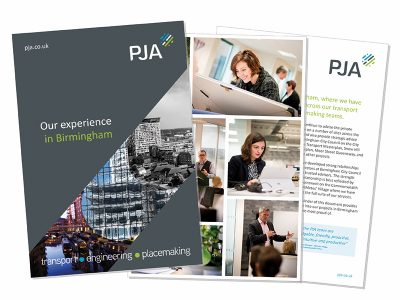
Named in January 2019 as the top city outside of London for business start ups*, Birmingham is the place to be.

Our business was founded in Birmingham, and with our head office located in the new Longbridge town centre that we helped to design, we continue to have a long and established relationship with the city.

PJA has over 40 professional staff based in Birmingham working across our transport planning, engineering and placemaking teams where we continue to advise on a number of sites across the city. We are proud to showcase our skills and projects in this vibrant and innovative city.

‘Our experience in Birmingham’ can be viewed here.


*source: Think tank Centre for Entrepreneurs

Colleagues and friends at PJA pay tribute to Ben Hamilton-Baillie who died from cancer aged 63 in March this year.

Phil Jones, chairman of transport planning, engineering and placemaking specialist PJA, started working with Ben nearly 20 years ago. Their first project was transforming busy residential streets near the centre of Ipswich into a ‘home zone’ – where traffic yields to pedestrians and cyclists in non-demarcated areas.

Phil said: “Ben challenged the way of thinking in highways that everything has to be regulated, with streets cluttered with signs, barriers and markings. He would say that we don’t need a sign to say don’t fart in church, nor do we need warning signs in swimming pool lanes – because people already know what to do! It was simple but challenging.

“Ben was a great guy. Fun to be around and a terrific public speaker. He put his ideas across in a really understandable and convincing way.”

PJA associate Annabel Keegan added: “My memories of Ben are of a generous and willing teacher who would always take the time to share his knowledge and offer advice.

“I loved listening to him speak at community presentations; he had such a relaxed and articulate way of explaining his design ideas that he was able to calm nervous residents and professional staff.

“He was a big story teller and I loved listening to him talk about his travels, and growing in different places around the world. He was a sociable man, and I will miss his cheeky twinkle and funny emails.”

PJA provided transport advice to help secure the redevelopment of the Astbury Hall estate near Bridgnorth, Shropshire. The development will provide 275 luxury lodges, a spa and fitness complex, bar and restaurant, tennis courts, bowling green, a lido pool and a golf course.

Our assessment included an examination of historical accident records on the rural B-road providing access to the site. Using this analysis we prepared a package of works to improve highway safety and reduce the risk of accidents, particularly where the road crosses the Severn Valley heritage railway. PJA also provided a Construction Traffic Management Plan which identified suitable routes for delivery of the holiday lodges, and set out principles for traffic management to minimise disruption to the local community.