UK Central Hub, Parking Strategy
PJA was commissioned by the Urban Growth Company (UGC) to develop a single unified parking strategy for the UK Central Hub area.
UGC is a special purpose delivery vehicle established to lead and develop major infrastructure investment in the UK Central area. It comprises a complex mix of operations including Birmingham Airport, the National Exhibition Centre (NEC), Birmingham International Railway Station, Birmingham Business Park, Jaguar Land Rover’s Elmdon factory as well as the upcoming High Speed Rail 2 (HS2) interchange and Arden Cross development.
The parking experience at present is fragmented, confusing, lacks consistency and requires a large management exercise for all the operators. Furthermore, this is a high growth area with expansions planned in the activities of all UKC member organisations, meaning parking capacity is likely to become a future constraint.
To improve the customer experience, provide resilience, increase revenues and reduce costs for all involved, PJA are developing an intelligent, unified parking scheme that brings all parking in the UKC Hub area under one operation.
The scheme comprises the following:
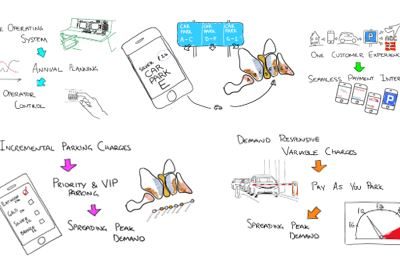
- A single IT system that provides communication between car parks allowing the real time optimisation, crisis management and ability for operators to open and close car parks;
- A seamless and consistent customer experience integrated with payment and sat nav systems;
- Segmented incremental pricing that differentiates car parks by price to reflect accessibility and amenity in relation to demands on a given day;
- Demand responsive pricing (surcharging) where the pricing mechanism can be used to smooth demands between car parks and vehicles on the network to limit congestion;
- Traffic management and wayfinding.
PJA have produced a governance and constitution framework, a development and implementation project programme, scoped out the requirement for infrastructure, and together with their partners Fluid7 developed the software requirement.
PJA have undertaken a financial modelling exercise which demonstrates that implementation of the scheme can increase car park utilisation, revenues and potentially rationalise car parking provision.
The scheme and particularly the pricing mechanism element is based upon strong transport economic theory including price discrimination/yield management, surcharging, demand elasticities, peak load pricing and joint costs, marginal external costs, information asymmetry as well as resultant economic welfare impacts.