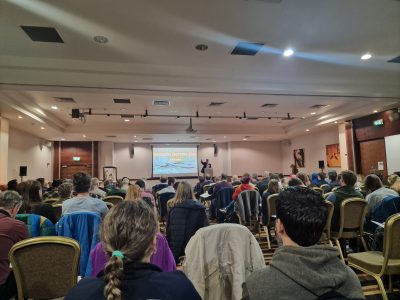
Our newly established nature team at PJA recently attended the Herpetofauna Workers Meeting, organised by ARC Trust in partnership with Amphibian and Reptile Groups of the UK (ARG UK).
The engaging conference provided invaluable insights, including innovative survey techniques, citizen science initiatives, and evidence-based mitigation strategies for amphibians and reptiles.
Here are our key takeaways for environmental and ecological professionals looking to enhance their conservation and monitoring practices.
Counting croaks: bioacoustics monitoring for natterjack toads
Traditional monitoring of natterjack toads is labour-intensive, requiring licensed ecologists to conduct nocturnal egg-string counts while carefully wading through breeding sites, resulting in minor disturbance. Given the remote locations of many populations, repeat surveys can be logistically challenging and time-consuming.
Because natterjacks are one of the noisier amphibians, a promising alternative explored at the conference was bioacoustic monitoring. This approach, widely accepted for bat population assessments, involves placing recording devices around ponds and using machine learning to analyse call patterns. The key benefits include:
- Non-invasive surveying: Eliminates the need for direct disturbance of habitats.
- Improved efficiency: Reduces the need for night-time fieldwork in remote locations.
- Enhanced accuracy: Machine learning can distinguish natterjack calls from other environmental noises, providing robust population estimates.
This method is now being considered for inclusion in established survey guidance as a precursor to licensing requirements, offering a non-invasive, cost-effective and data-rich alternative to traditional monitoring.
Citizen science & slow-worm surveys in the Highlands and Islands
A standout example of citizen science’s impact was a project mapping slow-worm populations in the Scottish Highlands. By engaging the public in recording sightings, the initiative doubled the number of verified records and uncovered populations in previously unrecorded areas.
Key takeaways include:
- The power of citizen science: Increased survey effort leads to more comprehensive datasets, helping to bridge gaps in species records.
- Survey effort matters: A single surveyor on one day may record just one slow-worm, whereas multiple participants over an extended period can dramatically increase records.
- Absence of records does not mean absence of species: This session highlighted the need for caution when interpreting gaps in data – species may still be present despite no prior recorded sightings.
This discussion reinforced the importance of Preliminary Ecological Assessments (PEAs) while acknowledging that incidental findings may still arise later in a project.
Evidence-based road mitigation for British herpetofauna
Infrastructure projects frequently incorporate mitigation measures such as tunnels and fences to reduce amphibian and reptile road mortality. However, this session stressed the need to move beyond simply confirming species use of these features and instead assess their effectiveness at the population level.
Key findings included:
- Research gaps: While mitigation features are commonly used, studies rarely examine their long-term benefits for population survival.
- Maintenance is crucial: A case study demonstrated how an unmaintained reptile fence failed to function as intended, leading to fatalities as animals bypassed the structure and attempted to cross the road.
- Holistic impact assessments: Future research should not only document species using mitigation features but also track the fate of individuals that fail to use them.
Key Conference Takeaways
- Innovative monitoring techniques, such as bioacoustics and machine learning, offer promising alternatives to traditional invasive surveys.
- Citizen science initiatives can significantly improve species records and conservation efforts.
- Infrastructure mitigation strategies require ongoing maintenance and population-level impact assessments to be truly effective.
- There is a need to shift from simply recording species presence to understanding long-term population trends.
- New technologies and public participation are crucial tools for closing data gaps and enhancing conservation planning.
The Herpetofauna Workers Meeting provided a wealth of knowledge and underscored the importance of continuous innovation in ecological surveying and mitigation strategies. As our nature team grows within PJA’s new environment service area, we look forward to incorporating these insights into our work and supporting our clients with the latest best practices in amphibian and reptile conservation.