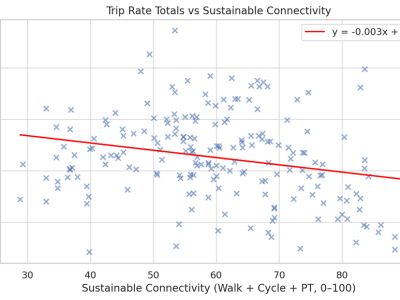
At PJA, we’ve long argued that where we build matters as much as what we build. Our latest analysis reinforces this: developments located in well-connected places – with good access by walking, cycling and public transport – generate significantly fewer vehicle trips than those that rely on the car for almost every journey.
Using data from nearly 200 housing-related sites in the national TRICS database, we compared real-world vehicle trip rates against the Department for Transport’s new Transport Connectivity Metric. The findings provide strong evidence that improving connectivity can directly influence how people travel, and ultimately how much traffic a new development produces.
Connectivity really does matter
The analysis shows a clear pattern: the better connected a site, the lower its vehicle trip generation. Sites with strong access to jobs, schools and shops by walking, cycling or public transport consistently produced fewer peak-hour car trips. It’s a simple but powerful conclusion – good connectivity changes behaviour.
The type of housing also plays a role
Flatted developments in accessible locations show the lowest car trip rates, reflecting a natural alignment between density and sustainable travel. Detached or suburban family housing, even in well-connected areas, tends to generate more car travel – though still less where active and public transport options are strong. For developers, this reinforces the importance of matching housing form to the level of connectivity a site can realistically offer.
Size isn’t the main driver
Interestingly, the number of dwellings on a site had little bearing on trip rates. Smaller schemes in highly connected places performed just as efficiently as large ones. This finding challenges the perception that only large developments can justify sustainable transport investment. Context – not scale – determines transport performance.
Designing for connectivity, not congestion
The latest National Planning Policy Framework (NPPF) encourages planning that “realises opportunities from existing or proposed transport infrastructure, and promotes walking, cycling and public transport use” (Paragraph 110). Crucially, connectivity isn’t fixed. It can be improved through design, investment and phasing. Developers can therefore model how enhanced connections – such as a new bus route or safer walking link – would reduce car trips over time. This allows for more optimistic, vision-led scenario testing, consistent with the NPPF’s “Decide and Provide” approach.
What this means for developers
- Evidence for decision-making: Connectivity metrics provide measurable evidence that can justify lower forecast traffic generation where access by sustainable modes is strong.
- Stronger engagement with local authorities: Demonstrating how improved connections reduce car trips aligns with both planning policy and local transport goals.
- Support for sustainable growth: Designing connectivity improvements into early masterplanning ensures that new places are future-ready, supporting the transition to healthier, low-carbon travel.
Conclusion
Connectivity isn’t just a planning buzzword – it’s a measurable factor that shapes how people travel and how much traffic a development generates. For developers, this means investing in connectivity can deliver tangible returns: smoother planning discussions, clearer sustainability benefits, and communities that work better for everyone.
In short, connectivity is now a core development asset – one that can be designed, improved and used to create genuinely low-traffic neighbourhoods.
Find out more about our services here
Sign up for more news from PJA here