Creating places that work for everyone begins with understanding the different ways people travel.
Recently, members of PJA took part in training delivered by the charity Wheels for Wellbeing, exploring the barriers disabled people face when travelling by cycle and how transport professionals can help remove them through inclusive design.
Shannon Connolly, Senior Consultant at PJA, shares some of the key insights from the session and why they matter for our work.
The importance of language
One of the first topics explored was the language we use when talking about cycling.
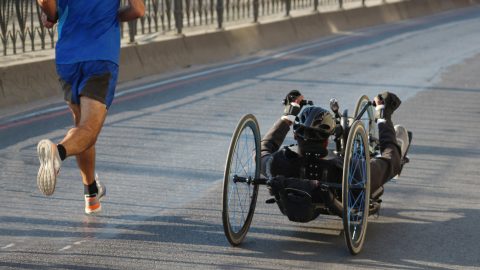
A bike or bicycle refers specifically to a standard two-wheel bicycle. The broader term cycle includes all types of cycles, including non-standard cycles such as tricycles, hand cycles and recumbent cycles. Referring to these as non-standard cycles rather than adapted or disabled bikes is important, as they are not exclusively used by disabled people and are not always adaptations of an existing bicycle.
In fact, the history of cycling challenges some common assumptions. The first known cycle was a hand cycle, invented in 1655 by Stephan Farffler, who was disabled himself. In many ways, the familiar two-wheel bicycle is an adaptation of that original design.
The training also highlighted the value of using the term walking, wheeling and cycling when discussing active travel. This helps distinguish between people travelling on foot and those using wheeled mobility aids, while recognising that cycling includes riders of both standard and non-standard cycles.
Further information on the recommended language to use in relation to walking, wheeling and cycling can be found here.
Understanding the barriers
The session explored the challenges disabled cyclists continue to face today, drawing on findings from Wheels for Wellbeing’s survey of disabled cyclists.
Infrastructure was identified as the biggest barrier by 53% of respondents, followed by a lack of suitable parking and storage (35%). For many disabled people, a cycle is more than a way to exercise or travel sustainably – it can be an essential mobility aid, making accessible infrastructure fundamental to independent travel.
The training also demonstrated how different cycle types have their own design requirements. For example, three-wheel cycles have very different handling and balance characteristics from a standard two-wheel bicycle, meaning infrastructure that feels comfortable for one user may present difficulties for another.
Another striking finding from the survey was that 64% of respondents said they find cycling easier than walking. This reinforces the importance of designing cycling infrastructure that enables more people to travel safely, comfortably and independently.
Further information on this survey, including a link to the full report, can be found here.
Designing for everyone
The training also introduced the fifth edition of Wheels for Wellbeing’s Guide to Inclusive Cycling, which provides practical guidance across active travel rather than focusing solely on cycling infrastructure.
Alongside advice on inclusive design, the guide introduces the concept of a pedestrian design vehicle to complement the cycle design vehicle used in LTN 1/20. This encourages designers to consider the space required by people using wheelchairs and other wheeled mobility aids when designing footways, helping create streets and public spaces that are genuinely inclusive.
As transport planners and engineers, we have an opportunity to shape places that remove barriers rather than create them. Training such as this is a valuable reminder that inclusive design is not about designing for the average user – it is about recognising the diverse ways people move and ensuring our streets enable everyone to travel with confidence.
Thank you to Wheels for Wellbeing for delivering such an insightful session and for continuing to champion inclusive cycling through research, guidance and advocacy.
Find out more about our services here
Sign up for more news from PJA here