The ‘Dutch-style’ roundabout at Fendon Road in Cambridgeshire is the first of its kind in the UK. Watch PJA Chairman, Phil Jones, as he explains how it works and tests it out.

The roundabout is designed to encourage motorists to drive at a slower speed, with a central over-run area allowing larger vehicles to manoeuvre around the roundabout. In the series of short videos below, Phil tests it out, explains how it works and talks about the pros and cons with the Urban Design Doctor, Dr. Stefan Kruczkowski, and David Singleton of DSA Environment & Design

Videos courtesy of the Urban Design Doctor YouTube Channel

Find out more about our services here

Sign up for more news from PJA here


Find out more

For more information please contact:

It’s said that the first 100 days in a role are pivotal to your success.

We’re not sure how true that is, things can take a little longer after all, but in honour of his first 100 days at PJA we spoke to Alan Lewis, an Associate Director from our Reading office. He talks about his career so far, what’s changed, what the challenges are and what he’s looking forward to in his future with PJA.


What do you enjoy about your role?

I love movies; some have left a lasting effect. City Slickers includes friends debating the meaning of their lives. Through the film they conclude their lives are unfulfilling because they don’t value their contribution to the world. I was determined my career would not feel like that.

In our industry, we explore local needs, present proposals to the public and then help public and private sector clients refine development and infrastructure proposals that will shape the built environment for a generation or more. We also contribute to design solutions that help communities adopt healthier lifestyle choices and critically we help preserve and protect the natural environment, so we play a small part in making a more sustainable world.


What would you say has changed most in your career?

In the early days of my career, traffic growth was 1-3%/year and we couldn’t wait to widen roads or build bypasses. In 20 years since the Kyoto protocol and Road Traffic Reduction Act, we’ve delivered half the changes we need to achieve net zero so we now routinely look at every alternative before we improve road capacity.

Over the years, demand for infrastructure, offices, leisure, retail and housing has ebbed and flowed. Being experts at moving people is not enough anymore, changes in retail have driven value from ‘just-in-time’ deliveries to anticipating where goods need to be, before people buy them. As we look forward, we’re combining GIS with big data to better understand how travel choices are going to change and how we can support sustainable patterns.


Do you specialise in a particular sector?

I’ve worked in the public and private sector, supporting proposals for developments and infrastructure at all scales. All proposals begin by examining the physical, economic, and environmental constraints of a site, area or corridor and requires consultants like us to explore ways to deliver the best value for everyone when delivering something new.

These days sustainability is top of the lists for ALL clients. Anticipating barriers to and the way people respond to changes is key to reducing costs and/or adding value, particularly when clients and their customers don’t yet know what they want/need. I take the view that the evidence is the evidence, you can’t dispute facts. By acting in the best interests of clients, whether they are public or private, means that we deliver better for both.


What are the emerging challenges?

Most of us accept the need to change, but it’s taken 25 years to convince us.  5 out of 7 Councils have declared a climate emergency; higher for urban areas (who know why); and, lower amongst County Councils (who realise how hard it will be to deliver net zero).

We plan 10-15 years into the future and 2050 is not far now. Governments are exploring ways to decide and provide what our transport network needs to look like, so it is great to work for PJA are playing an active role for the public and private sector.

Fortunately, Millennials are entering the workforce and Generation X, most of whom are in the ‘peak car’ generation, will start to retire in coming years so there are some things that are going to make it easier.

Work, shopping and leisure patterns and school choices are still influenced by proximity / accessibility, but people have adapted their lifestyles, travel needs or shifted to buying on-line. PJA continue to innovate and develop tools to show past, present and future trends and anticipate change. Town centres continue to lose their (working) lunchtime spend, diversifying to leisure cannot offset the losses so the shift to internet sales seems worse than it already is; at the same time, rising energy costs drive demand for more efficient housing; and, evolving lifestyles continue to drive change.

As I see it, planning authorities have three core options:

  1. Deliver strategic urban extensions and new settlements, integrating land uses and infrastructure to support changing lifestyles
  2. Allocate employment land near transport corridors to meet demand, thereby enabling regeneration of more accessible urban sites.
  3. Facilitate large scale regeneration plans.

And for the UK to strive beyond Europe, we need some strategic planning to support rail, air and sea ports and refine regional mineral, waste and energy demands.

In my opinion, the biggest challenge is convincing those who can’t see the need. So, if we’re busy now, we’re going to get a whole lot busier, as we need to repurpose more streets to facilitate future vehicles and Mobility as a Service whilst preserving and delivering a sense of place.


What’s next?

I began my career with simple aspirations. In my early years I was thrown in the deep end because colleagues were seconded to Department for Transport. When these young professionals returned, they were invested in a training programme and wanted willing guinea pigs to practice presentations . The environment fed my natural curiosity to learn things, where a ‘pay-it-forward’ mentality encouraged me to build a portfolio of lunch and learn lesson plans that I am looking forward rolling out at PJA.

Over periods of economic uncertainty our industry has struggled to invest in training and future leaders, PJA are putting that right and wanted people to join who share their leadership vision. I learned to teach as a reservistwhere you realise we all have something to bring to the table. I enjoy teaching others because I’ve started to see their achievements, whether that is gaining their MSc, Chartered qualifications, advise Governments or set up and build a business. My career success came from those who taught me. If I can repay them by teaching others, we might get to see them achieve their potential.


Alan Lewis, Associate Director
Alan has over 30 years’ experience in transport, infrastructure, environment and planning. He has worked on many private and public sector projects at a variety of scales from a few dwellings to new settlements as well as a multi-billion entertainment complex. He has supported local authorities with their Local Plan evidence, delivered business cases and contributed to national and local design standards and policies.
Get in touch with Alan: [email protected]


Sound like a company you’d like to work for? View our current vacancies here

Find out more information on our services here

Sign up for more news from PJA here

Our wonderful team are our greatest asset. Not only experts in transport, engineering and placemaking but also committed to delivering better places for people through high-level-service client experiences.

We’re very proud to continue to celebrate the faces behind the fast-growing international consultancy that we are today in our monthly feature ‘PJA People’.

Next up in our series is Director, Sam Williams, based in our Melbourne office:


Tell us what you do at PJA

I relocated from PJA’s Birmingham office in 2019 to establish our first international office in Melbourne, Australia. My role now is to lead and grow our Australian team focusing on a broad range of development projects, ranging from industrial and mixed use developments, town planning applications, road safety audits and civil / traffic engineering services. We have a growing presence in Melbourne and establishing a strong reputation for the high quality services offered.


What’s your career path so far?

I didn’t follow the traditional career path and started out designing telecommunication sites, this provided a great foundation for drafting skills and site surveys. After spending a short time on site I moved into an engineering apprenticeship, 7 years later I graduated with a 1st class honours in Civil Engineering. Now leading the Melbourne team provides a real opportunity to make a difference and create an inclusive office that provides opportunities to develop on all fronts working on a diverse mix of projects.


What do you enjoy when you’re not working?

I have a 19 month old son that certainly keeps my on my toes, but we love getting out hiking and camping with Wilsons Promontory National Park being our favourite place in Victoria.


Are you a dog or cat person?

A dog person, although we don’t have one yet I am sure we will welcome one to the family in the future.


What are you currently reading or listening to?

‘Eat That Frog’ by Brian Tracy, a great way to switch off but also helps to focus on the important items of the day.


Claim to fame?

I have been on the TV show ‘DIY SOS’ many years ago while based on site.


Sam Williams, Director

Sam heads up the Melbourne office of PJA and has over 11 years’ experience in civil engineering design consultancies.

He has worked on a wide range of projects including: development infrastructure, public realm improvements, national cycle routes and urban regeneration.

Sam brings a genuine passion for early engineering engagement at concept stage to ensure that a creative and credible design can be delivered.

Get in touch with Sam: [email protected]


Find out more about our services here

Read more in our PJA People series here

Sign up for more news from PJA here

Our founder and Chairman Phil Jones has been appointed as Technical Advisor to Adam Tranter, the West Midlands Cycling and Walking Commissioner.

It is the latest high-profile appointment for Phil who is recognised nationally and internationally as an expert in the planning and design of highway infrastructure. Over the past 20 years he has contributed to national policy and guidance that has created a sea-change in favour of walking and cycling.

In this latest role Phil will support Adam to deliver the West Midlands Mayor Andy Street’s vision of enabling many more people to walk and cycle short journeys instead of using the car.  He will provide high-level technical advice and support to future active travel schemes, find creative solutions to technical challenges to benefit active travel in the region and engage with engineers within Transport for West Midlands (TfWM), Midland Metro Alliance and local authority partners to ensure high-quality delivery for active travel.

Adam Tranter, Cycling & Walking Commissioner said: “The West Midlands needs a major improvement in the quality and extent of dedicated infrastructure if we’re to meet our active travel potential. It is clear we need safe and convenient options to enable people to travel more healthily and sustainably.

“I am delighted to welcome Phil to the team as he will provide timely and authoritative advice enabling us to have maximum impact. He has immense expertise in planning and designing for walking and cycling, including in-depth knowledge of Local Transport Note 1/20 Cycle Infrastructure Design, the ground-breaking government guidance issued in 2020, which Phil co-authored.”

Phil Jones added: “I am really pleased to have been appointed to this very significant role in my home county. There is big ambition here and we need to make sure we support the change in the way our streets work for active travel.

“A big part of my role is to help raise knowledge and skills across the region in how to achieve world-class infrastructure that will meet the stringent demands of Active Travel England, the national funding body.”

Find out more about PJA and our services here

Sign up for more news from PJA here

 

“What’s going on in the ground is fundamental to designing places” explains Mike Poland, Director of Ground and Groundwater Engineering based at PJA’s Birmingham headquarters.

“We pride ourselves and understanding the interface between the sub-surface environment and a wide range of design interfaces, from placemaking to engineering. The geotechnical aspects of our work consider the way the ground behaves when modified or put under stress. This requires the assessment of the properties of soil, rock and groundwater to predict how, for example, the ground will support a new foundation or how a newly formed slope may behave.

On the geoenvironmental side we look at pollution within the ground and groundwater environment from historic processes and the risks posed to humans and the wider environment. By assessing the ground, in its broadest sense, we can anticipate risk and abnormal costs at an early stage and mitigate where appropriate.”

The chartered geologist heads up PJA’s ground team and is the first port of call for developers wanting to find out about the development potential of their scheme. In addition to ground and groundwater assessments, Mike works with the wider PJA team to advise on access, highways, flooding attenuation, drainage, green corridors and heritage.

His portfolio of projects range from large multidisciplinary strategic developments to landfill sites and greenfield and brownfield land assessment across the UK. For example, the Coed Darcy project involves the reclamation, remediation and re-engineering of the former oil refinery in Llandarcy, Wales, for residential purposes. Similarly, his team are leading the approach to sensitive reclamation and land re-modelling at a proposed mix used development adjacent to the World Heritage Site at the former Ironbridge Power Station.

On all projects sustainability is increasingly important element in contributing to the whole circular economy of a project. Important in this respect is advising on how waste materials generated on sites can be recycled for beneficial reuse and reduce carbon footprint. An early understanding of the materials balance across a site can have a significant impact on the development of the masterplan and ultimately the viability of a scheme. For example, on many greenfield developments incorporating the known excess of topsoil at an early stage provides sustainable benefits, encourages innovative thinking and influences the overall feasibility of a project.

“It’s really important from initial design through to construction that developers show they have sustainable solutions to the technical and environmental risks of their land, and that’s what we help with. We think holistically about projects from the very start, and work across disciplines looking at how we can enhance the design process.

“We often work closely with ecologists and landscape specialists to understand how we can enhance biodiversity. Understanding how materials behave can lead to the creation of important micro-habitats. For example, re-shaping of slopes in rock can, if carefully managed, evolve from simple engineering features, which are fenced and stabilised, to important aesthetic elements within a development which provide diverse habitat for reptiles and specialist flora’’.

Mike and his team welcome the clarity new guidance and legislation could bring to the design process, for example, the new Environment Act. This also poses challenges to engineers and developers alike and makes early-stage planning and design ever more important. Water quality, drainage balance, the protection of sensitive environments and water ‘neutrality’ feature highly:

“More so than ever design professionals need to have an integrated approach to land development and PJA’s Ground and Groundwater team are central to this drive and are passionate about increasing biodiversity, restoring natural habitats, reducing waste and making better use of resources’’.

“These are big changes but they are much needed because sustainability and biodiversity enhancement is so important. However, ultimately the outcome for landowners and developers will be better quality, attractive developments.”

Mike grew up in Nottingham and says his love for the outdoors stems from the many visits to the Peak District. After leaving school he had jobs in a hospital laboratory, in a paper merchant and behind a bar before enrolling for a degree in geology at Oxford Polytechnic. This was followed by a master’s degree in geology at Durham University.

His first job was for Exploration Associates as a site investigation contractor, where he started to learn the ‘basics’ on sites across the UK and abroad. This was followed by posts at Carillion, BAE Systems and Atkins before joining PJA in 2017.

For a ground investigator, Mike says that one of the biggest thrills is when the ground is revealed for the first time and new discoveries are found. Although he has less time to spend ‘digging holes’ these days, the passion for the investigation of the ground remains.

Get in touch with Mike: [email protected]


Mike Poland, Land Development Director

Mike has 25 years’ experience in the regeneration of brownfield land, and is the technical director for the overall land development team. Mike works in business development, acts as a project director and provides project technical support.

BSc (Hons) MSc CGeol FGS


Find out more about our services here

Sign up for more news from PJA here

Find out more

The Environment Agency’s Climate Change Allowances Guidance in relation to peak rainfall intensities was significantly updated on the 10th May 2022 adopting a Management Catchment approach in England, rather than a National Scale application which was previously utilised.

Our Water Resources Team have reviewed these changes and summarise what they are and how do they could potentially impact development proposals:

Climate change allowances were previously applied on a National Scale across the whole of England. The country has now been divided into 92 Catchment Management areas, each with its own set of climate change allowance values, which aligns with the methodology adopted for delineating peak river flow allowances. They have also given different climate change allowances for the 1 in 30 year and 1 in 100 year events and further to this, the epochs that the climate change should be applied to has also been reduced from three to two.

The updated guidance seeks to simplify how climate change should be applied by type of development, stating that:

    • Use the development lifetime guidance to work out the lifetime of your development
    • You should consider residential development to have a minimum lifetime of a 100 years
    • Design your development so that for the upper end allowance in the 1 in 100 year exceedance probability event:
      • there is no increase in flood risk elsewhere
      • your development will be safe from surface water flooding
    • For development with a lifetime between 2061 and 2100 take the same approach, but use the central allowance for the 2070s epoch (2061 to 2125)
    • For development with a lifetime up to 2060, take the same approach but use the central allowance for the 2050s epoch (2022 to 2060)
    • In some locations the allowance for the 2050s epoch is higher than that for the 2070s epoch. If so, and development has a lifetime beyond 2061, use the higher of the two allowances

Potential Implications

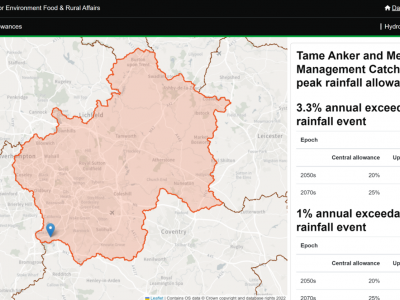
In simple terms, the new climate change allowances are applied on a Management Catchment basis. This could mean that two sites in two different Management Catchments, but in relatively close proximity to each other, could require different climate changes allowances to be applied. These values are now provided within a new online GIS tool, an extract of which is contained below.

At present there is no guidance on how to apply the climate change allowance if a site sits between two Catchment Management Areas; however, it may be presumed that the higher climate change value is applied as a precautionary approach.

This means that drainage strategies and designs will now be potentially required to apply a 50% or 45% climate change allowance in rainfall will take immediate effect. This may have an impact on your current and proposed drainage strategies currently.

These changes are aimed to protect development against flooding but will have a material impact on the size and form of attenuation facilities that in turn will affect development masterplan layouts.


Further Questions?

For further information on these changes or clarification on the implications of these changes to your proposed develop site, please contact our water resources team:

Jerry Muscroft, E: [email protected]  T: 07732 601 245

Andrea Nelmes, E: [email protected] T: 07999 830 246

Phoebe Ryding, E: [email protected] T: 07872 858 452

Malcolm Crowther, E: [email protected]  T: 07876 235 111


Find out more about our services here

Sign up for more news from PJA here

 

What makes good street design? Quite a lot as it happens, with benefits for people, health and quality of life being the top factors. We asked Rebecca Jones, who is about to celebrate her first anniversary as a Principal Consultant at our London office, to tell us more.

I have been working in street design for a number of years now, and along the way I have learned a few things about what makes a good street! For me, a key place to start is considering the whole street environment – not just kerb to kerb. Streets perform both a place and a movement function, and as designers we need to understand where each street sits on this spectrum, and also establish if this is something we can look to change. We need to ensure streets work for all users, but in particular we need to look to prioritise sustainable and active travel modes where possible.

The Healthy Streets concept introduced an approach to street design that considers the wider functions of a street beyond movement, and recognises the importance and potential to transform our streets in to assets for all to enjoy. From a design perspective, making a street healthier can be as simple as providing wider footways or improving lighting, to more major interventions like protected cycle facilities or filtering a street to through-traffic. This is key, as streets make up 80% of all open space in towns and cities, space that can be designed to benefit the whole community.

It’s easy to feel like some of our streets are made with only cars in mind. With someone being killed or seriously injured on UK roads every 22 minutes◊, and fear of road danger being the most common reason people don’t cycle, it is key that we look to make our streets safer for all. When I am looking at improving a street for walking and cycling, my first port of call is to see whether the speed and volume of traffic can be reduced. When we think about slowing traffic, we might initially think of more traditional traffic calming measures such as speed humps, but other measures such as greening, narrowing the road and using different materials can all signal to drivers to slow down and take care. Reducing through-traffic also has to potential to transform any street into a healthy street at a relatively low cost, as without the worry of passing cars walking and cycling is more attractive, children can play outside, parents relax, neighbours get to know each other better and a more cohesive and safe community for people to live and work in is created. In turn, people are more active and less isolated, and the benefits of increased physical exercise and social connectivity can lead to major health improvements.

I started cycling as an adult when I moved back to London after university and couldn’t afford the Tube. While I was nervous at first, I found that once I experienced the freedom that cycling brings, I didn’t want to go back! If we want to see modal shift though, we need to make our streets safer and inviting for all, to ensure that people are able to make a choice as to how they travel.

An example of changing an existing street to be more people-focussed is one of my projects, Windmill Drive in Lambeth. During the COVID-19 Pandemic, Lambeth Council trialled filtering this street that runs through the popular Clapham Common to through-traffic for several months. Following this successful trial, whereby the scheme was well-received by visitors and residents alike, I designed a permanent scheme for the street. The scheme aims to transform Windmill Drive in to a high quality urban realm environment that maintains its key movement function for pedestrians and cyclists whilst de-paving much of the street to provide enhanced planting and sustainable urban drainage systems. Additional features such as seating, cycle parking and insect hotels all help to transform this street into more of a ‘place’ for all to enjoy. The scheme is currently progressing so watch this space for updates!

Get in touch with Rebecca: [email protected]

Rebecca is a highway engineer and transport planner based in our London office. She has over ten years’ experience in the sustainable transport industry, and has worked within the public, private and not-for-profit sectors.

Rebecca advises on street design, transport planning and sustainable travel for mainly local authority clients. Her technical expertise includes concept and detailed design of cycling and walking infrastructure, as well as GIS mapping, network planning, data analysis and project management. She has extensive experience of community engagement and co-design, and has worked on projects both in London and across the UK.

https://www.brake.org.uk/get-involved/take-action/mybrake/knowledge-centre/uk-road-safety

Find out more

For more information, please contact:

A recent report by Transport for New Homes Building Car Dependency warns that too many new developments are building in dependency on cars. The report notes that, despite the vision for vibrant communities set out in the NPPF, this is not what the planning system is currently delivering.

The report argues against the current emphasis on housing targets and recommends that planning policy should focus on identifying the most sustainable places to build. It states that building large new housing developments on greenfield sites near motorway junctions or bypasses encourages new traffic onto roads and adds to congestion by requiring people to drive for virtually every journey. In contrast, the report finds that brownfield sites are generally far more suitable for people wanting to walk, cycle or travel by public transport. It recommends that the National Planning Policy Framework (NPPF) is redrafted to require that all new development is designed around sustainable transport – walking, cycling and public transport.

What do we think about this proposal?

The NPPF undoubtedly needs to be strengthened to ensure new developments are as sustainable as possible, but the report misses a number of steps. Quite often, failing transport systems are the result of poor land use planning, and so we should first be talking about introducing a ‘brownfield first’ policy; policies to ensure we deliver higher density urban centre development and ‘transit-oriented developments’; policies aimed at putting amenities in the right places to reduce the need to travel; and, guiding local authorities to set intelligent parking standards and abolishing parking minimums. It is also important to remember that we have a huge housing shortage and a major demand for economic development and we need to have a balanced and open debate to avoid potential unintended consequences of changing planning policy.

The report is correct in that it is possible to deliver sustainable developments on greenfield sites. Urban extensions that connect to existing streets and public transport work well, but we would add that any urban development or new settlement needs to be large or dense enough to sustain the schools, shops and other amenities needed for liveability and localisation. So, giving developers more certainty about what is expected from them when they do this is very important.

The NPPF already says a lot of the right things about sustainable development and transport but we still end up with car centric developments. So reports like this are helpful to start the discussion with professionals to understand what barriers are preventing more developments coming forward that facilitate sustainable living.

We agree that there is need to address systemic failures created by the open framework but there is also much to do to solve the skills gap, the lack of pragmatism in the planning process, the ill thought through local policies and the lack of funding to support developments that tick all the right sustainability boxes but remain unviable.

What can be done to ensure homes are built around sustainable transport and what are the difficulties in establishing sustainable transport links in new and existing?

Choosing the right location is key to delivering sustainable development, moreover the mix of land uses and the design of new developments is important to ensure walking and cycling are the natural choice for short journeys and that public transport is accessible. This is what placemaking is all about, and it is why we believe that the NPPF should be placemaking led before it is transport solutions led.

Beyond that the new government guidance on local transport plans is expected to be published this spring, which will help local authorities develop plans that align with key sustainable transport policies such as Bus Back Better, Gear Change and the Decarbonisation of Transport Strategy and it’s important that local authorities are given the resources to refresh their Local Plans with this evidence as quickly as possible.

Local Cycling and Walking Infrastructure Plans (LCWIPs) are critical to the answer here, which show what new and improved active travel infrastructure is required. Gear Change and LTN1/20 Cycling Infrastructure Design also help by providing clear guidance to professionals on the quality of infrastructure required on new and existing highways. There is a huge amount still to do to upskill the industry in planning and designing sustainable places and PJA has been actively supporting the establishment of Active Travel England and delivering LTN1/20 training to transport professionals in the public and private sectors.

The biggest challenge currently facing the industry is in building a credible evidence base to quantify and communicate the benefits of sustainable development. This is less easy to demonstrate than the well-established traffic models because the empirical data is not there. We need better and focussed data on the beneficial impact of good development and infrastructure on trip making and mode choice. Unfortunately, the next Census output is unlikely to yield sufficiently robust data to this end. PJA alongside others are developing new approaches to this, but an industry standard approach is required which professionals, decision makers and examiners can get behind.

The future is brighter than people think, however. Today PJA is more regularly working on developments where 100% of infrastructure spend is given over to sustainable transport measures, and masterplans are being produced where 20-minute neighbourhoods can be considered a reality. As the next batch of greenfield developments are more difficult to make sustainable and the bar is being set even higher by policy, developers are willing to work much harder on the sustainable credentials of their sites to secure allocation in the Local Plan.

What is needed in rural areas, which have fewer options?

We need to be careful about proposing new developments in rural areas as they will be inherently less sustainable than more urban sites, due to the longer distances that people need to travel and lower densities to support public transport or investment in active travel infrastructure. Hence our view that rural developments can only be considered sustainable if they are big enough to be self-sustaining, or connected well enough to reduce the need to need to travel in private cars.

However, this needs to be balanced with wider policy considerations such as providing new affordable housing in rural villages meaning that some small-scale development will need to be accommodated. This doesn’t help the transport problem but exacerbates it particularly when the commercial model of rural public transport doesn’t work and there needs to be recognition that bus routes must be subsidised or alternative lower cost solutions found.

We should not let rural residential development off the hook. It still needs to be walkable to shops and services and supported by high-speed broadband, and possibly ideas such as community co-working spaces and mobility hubs, which could provide e-bike and car share and demand responsive transport solutions.

What needs to change for developers to deliver in more sustainable locations? Where do local plans or spatial planning come into this? What is the role of transport planners here?

While there are a number of factors that influence the identification of development sites, accessibility is a crucial factor which has a significant impact on the sustainability and success of development and therefore transport planners should play a key role in the identification of suitable development sites for Local Plans.

The planners need more input from the strategic transport planners to ensure that the land use mix is right, and that development is concentrated in areas that can most easily be upgraded to provide the accessibility it needs. The ability of local authorities to do this thinking supported by a robust evidence base has been weakened by funding cuts and shifting national policies and housing targets.

Local authorities should also make use of the skills and experience of transport planners in the private sector. PJA has produced many sustainable transport strategies for local authorities to support updates of their local plans. We consistently demonstrate that additional land can be allocated for development with mitigation strategies involving improvements to public transport, walking and cycling infrastructure to enable mode-shift from private motorised car trips.

What does the government need to do, given its focus is on electric vehicles?

Cars are going to continue to be a significant part of the transport mix for the foreseeable future so, in addition to resolving tax implications of a shift from petrol and diesel to all electric vehicles, it’s important that we get things right when it comes to charging infrastructure. Key considerations include ensuring charging points for cars parked on street don’t create trip hazards or obstructions on footways, or hinder opportunities to reallocate road space to more sustainable modes or lock in private car ownership. New building regulations require chargers to be at least 7KW for new development, which could mean significant infrastructure costs for new developments away from good quality grid connections.

Nevertheless it is incorrect to think that the government is just focusing on electric vehicles; active travel and public transport are key themes of the Decarbonising Transport plan. While electric vehicles are cleaner, we still need to solve issues such as particulate emissions from brake dust. EV’s are also not the solution to congestion, public health or road safety. The publication of Gear Change in July 2020 marked a step change in the expectation on local authorities and developers to build quality active travel infrastructure and this will be enforced by Active Travel England, a new Ofsted-style inspectorate that will be a statutory consultee on larger planning applications. This is a game changer and we should wait to see how it pans out.


We understand the challenges faced by developers: helping them shape their approach to navigate the UK’s planning process.

Made up of some of the UK’s leading transport planners, engineers and place makers, we work together to create better places through great design.

Find out more about our services here

Sign up for more news from PJA here
Our wonderful team are our greatest asset. Not only experts in transport, engineering and placemaking but also committed to delivering better places for people through high-level-service client experiences.

We’re very proud to continue to celebrate the faces behind the fast-growing international consultancy that we are today in our monthly feature ‘PJA People’.

Next up in our series is Marketing and Graphic Design Manager, Julie Cadwallader, based in our Birmingham office:


Tell us what you do at PJA

I manage the marketing here at PJA and the graphic design service we offer. I work with teams around the business to support them and also offer graphic design as a direct business stream to clients externally. I really enjoy being able to make something communicate clearly through visual aides. Having been in the planning and development field for over 19 years now, I’ve definitely come across a lot of projects but each day is still different and challenging.


What’s your career path so far?

I joined MRP (Mason Richards Planning) working in the planning and transport team back in 2003. MRP turned into RPS where I continued to work in the planning and transport team before moving in to the marketing and bid management team. Moving to PJA in 2018 brought all of those skills I’d gained together in one role.


What do you enjoy when you’re not working?

I spend a lot of weekends walking around old buildings and beautiful gardens – I really enjoy a bit of history.


Are you a dog or cat person?

A dog person. Although not the big jumpy loud kind until I get to know them!


What are you currently reading or listening to?

I’m currently reading ‘The Man Who Died Twice’ by Richard Osman and really enjoying it!


Claim to fame?

I spotted Alexander Armstrong in the distance a few years ago, does that count?!


Julie Cadwallader, Marketing and Graphic Design Manager

Julie has over 19 years’ experience in the development planning consultancy industry.  She leads our marketing outputs, the quality of our visual presentation and our graphic design service.

Our in-house expert graphic design team offer clients a bespoke service that includes map presentation, desk top publishing and digital design.

As specialists in the built environment, we understand the complexities of the information given to us and, using the latest software, transfer this into a style that clearly communicates to a range of stakeholders.

Get in touch with Julie: [email protected]


Find out more about our services here

Read more in our PJA People series here

Sign up for more news from PJA here

The consultation period for the environmental targets set by the government last month is nearly over, how might they impact your projects? We look into the announcement and how it could impact on future developments from a transport perspective.

In March 2022 the government announced new long-term environmental targets. The proposed targets are part of the Environment Act which passed into law in November 2021 and aims to protect and enhance our natural world.

The proposed targets cover a wide range of avenues including water, diversity of wildlife, waste, tree cover and Marine Protected Areas. Of particular interest to transport planning are the targets proposed around air quality.

Air pollution poses the biggest environmental risk to public health and is a particular risk to vulnerable groups, including the elderly, the very young, and those with existing health conditions.

The Government is proposing two key targets in relation to Air Quality:

  • A maximum annual mean concentration of fine particulate matter (PM2.5) 10 µg/m3 across England by 2040; and
  • A 35% reduction in population exposure to PM2.5 by 2040 (compared to a base year of 2018).

Transport plays a significant role in air quality and is the main source of NO2 emissions accounting for 34% nationally(a). Transport’s role in PM2.5 emissions is smaller but still significant, accounting for 12% of these emissions at a national level. This figure can vary significantly though depending on location with road transport accounting for 26% of PM2.5 emissions in city centres(b).

What does this mean for developments?

Electric vehicles offer significant overall benefit to air quality in cities through the removal of tail-pipe emissions. However, specifically in relation to PM2.5 the benefit of a switch to electric vehicles is less clear cut, as the principal contributor in relation to transport is tyre and break wear.

Given the additional weight of electric vehicles and associated increased tyre wear, electric vehicles, particularly those with larger battery capacities, are likely to result in increased PM2.5 when compared to conventional petrol vehicles(c).

Whilst providing infrastructure for electric vehicles will remain an important element of all new developments, a more fundamental change will be required to help achieve the government’s PM2.5 reduction targets involving a significant modal shift built around promotion of public transport and active travel over private vehicles.

The key to achieving a significant modal shift will be in choosing the right location for developments with access to a mix of land-uses and ensuring that the design of new developments prioritises walking and cycling as the natural choice for short journeys with public transport available for longer journeys.

This approach is however in line with key sustainable transport policies such as LTN 1/20, Gear Change and Bus Back Better as well as the objectives of the recently updated Highway Code and, therefore, there should be a progressive reduction in PM2.5 arising from transport as schemes come forward set against this higher emerging policy bar.

Active and sustainable travel interventions, either to support development schemes or delivered by local authorities, should be recognised as not only solving mobility issues but also making important contributions to these emerging air quality targets.

The proposed targets are now in an eight-week consultation period ending on 11th May 2022 where government is seeking the views of environment groups, local authorities and stakeholders.

PJA were the lead author of LTN1/20, the Government’s cycling infrastructure design guidance which was published alongside ‘Gear Change’, co-authored the guidance on Local Cycling and Walking Infrastructure Plans and are now helping to establish Active Travel England.

We understand the challenges faced by developers: helping them shape their approach to navigate the UK’s planning process.

Made up of some of the UK’s leading transport planners, engineers and place makers we work together to create better places through great design.

Find out more about our services here

Sign up for more news from PJA here

(a) Defra (2019), Clean Air Strategy. London: The Stationery Office.
(b) BEIS 2019. UK National Atmospheric Emissions Inventory (NAEI)
(c) https://www.oecd-ilibrary.org/sites/e1bc711b-en/index.html?itemId=/content/component/e1bc711b-en