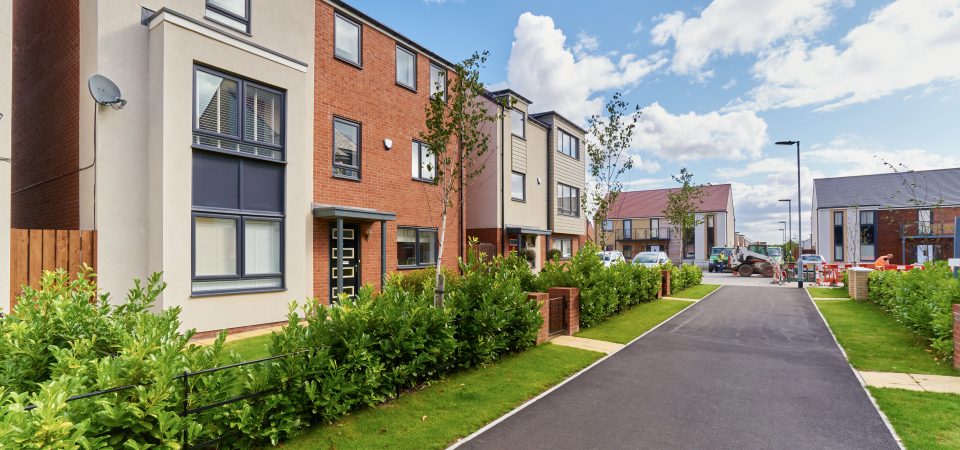
What makes good street design? Quite a lot as it happens, with benefits for people, health and quality of life being the top factors. We asked Rebecca Jones, who is about to celebrate her first anniversary as a Principal Consultant at our London office, to tell us more.
I have been working in street design for a number of years now, and along the way I have learned a few things about what makes a good street! For me, a key place to start is considering the whole street environment – not just kerb to kerb. Streets perform both a place and a movement function, and as designers we need to understand where each street sits on this spectrum, and also establish if this is something we can look to change. We need to ensure streets work for all users, but in particular we need to look to prioritise sustainable and active travel modes where possible.
The Healthy Streets concept introduced an approach to street design that considers the wider functions of a street beyond movement, and recognises the importance and potential to transform our streets in to assets for all to enjoy. From a design perspective, making a street healthier can be as simple as providing wider footways or improving lighting, to more major interventions like protected cycle facilities or filtering a street to through-traffic. This is key, as streets make up 80% of all open space in towns and cities, space that can be designed to benefit the whole community.
It’s easy to feel like some of our streets are made with only cars in mind. With someone being killed or seriously injured on UK roads every 22 minutes◊, and fear of road danger being the most common reason people don’t cycle, it is key that we look to make our streets safer for all. When I am looking at improving a street for walking and cycling, my first port of call is to see whether the speed and volume of traffic can be reduced. When we think about slowing traffic, we might initially think of more traditional traffic calming measures such as speed humps, but other measures such as greening, narrowing the road and using different materials can all signal to drivers to slow down and take care. Reducing through-traffic also has to potential to transform any street into a healthy street at a relatively low cost, as without the worry of passing cars walking and cycling is more attractive, children can play outside, parents relax, neighbours get to know each other better and a more cohesive and safe community for people to live and work in is created. In turn, people are more active and less isolated, and the benefits of increased physical exercise and social connectivity can lead to major health improvements.
I started cycling as an adult when I moved back to London after university and couldn’t afford the Tube. While I was nervous at first, I found that once I experienced the freedom that cycling brings, I didn’t want to go back! If we want to see modal shift though, we need to make our streets safer and inviting for all, to ensure that people are able to make a choice as to how they travel.
An example of changing an existing street to be more people-focussed is one of my projects, Windmill Drive in Lambeth. During the COVID-19 Pandemic, Lambeth Council trialled filtering this street that runs through the popular Clapham Common to through-traffic for several months. Following this successful trial, whereby the scheme was well-received by visitors and residents alike, I designed a permanent scheme for the street. The scheme aims to transform Windmill Drive in to a high quality urban realm environment that maintains its key movement function for pedestrians and cyclists whilst de-paving much of the street to provide enhanced planting and sustainable urban drainage systems. Additional features such as seating, cycle parking and insect hotels all help to transform this street into more of a ‘place’ for all to enjoy. The scheme is currently progressing so watch this space for updates!
Get in touch with Rebecca: [email protected]
Rebecca is a highway engineer and transport planner based in our London office. She has over ten years’ experience in the sustainable transport industry, and has worked within the public, private and not-for-profit sectors.
Rebecca advises on street design, transport planning and sustainable travel for mainly local authority clients. Her technical expertise includes concept and detailed design of cycling and walking infrastructure, as well as GIS mapping, network planning, data analysis and project management. She has extensive experience of community engagement and co-design, and has worked on projects both in London and across the UK.
◊ https://www.brake.org.uk/get-involved/take-action/mybrake/knowledge-centre/uk-road-safety