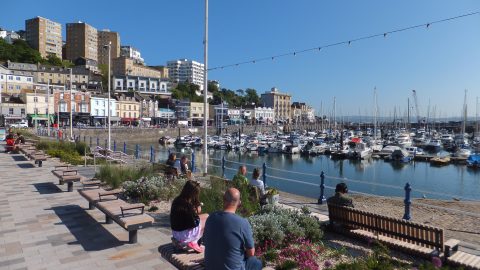
The Strand Harbour Public Realm project has redefined Torquay’s waterfront, transforming a traffic dominated corridor into a people-focused, vibrant, and inclusive public space.
The Objective
To restore Torquay’s historic waterfront as a vibrant, inclusive and sustainable focal point, addressing two decades of visible decline, poor pedestrian connectivity and the dominance of traffic. The ambition was for The Strand to create a social, cultural and economic destination for multiple users, but one that was rebalanced in favour of people rather than traffic.
The Challenge
The harbour area was dominated by traffic: A dual carriageway severed the town centre from the waterfront and as a main through route, vehicles were channelled through the space. Restricted traffic movements forced vehicles to U-turn along the harbourside, intensifying congestion. The area also functioned as Torquay’s main bus layover, with up to 60 buses passing through at peak times obscuring the harbour vista. Meanwhile around 2,000 pedestrians crossed the highway during peak hours, alongside seasonal fluctuations linked to tourism.
The Work
The vision centred on reimagining The Strand as a people-focused destination through a bold reallocation of road space to create an accessible and high-quality public realm. Delivering this required a fundamental reconsideration of how traffic moved through the area, redesigning routes to support, rather than constrain.
Extensive data collection and movement analysis provided the evidence to explore alternative street layouts, stress‑test design scenarios and understand the impacts of reducing traffic dominance. This included assessing pedestrian flows, bus layover activity, U‑turn patterns and seasonal fluctuations driven by tourism.
Insights gathered through workshops, design sessions and consultation events informed the proposals, ensuring they addressed genuine local needs and responded to the lived experience of those who use the space daily.
Work progressed through the RIBA stages with clear milestones, including design freeze points, risk reviews and data‑driven transport assessments ensuring each stage was informed by evidence and community insight before adapting and continuing.
Early engagement with operators and building contractors helped to mitigate issues and risks, whilst the project adapted to incorporate opportunities that arose.
The Result
The project has delivered substantial improvements in the quality, safety and functionality of Torquay’s waterfront. It has met all the objectives set out and generated long lasting environmental, social and economic benefits.
The simplification of traffic movements and relocation of heavy bus layover activity have delivered environmental and safety improvements, reduced severance and created intuitive, accessible routes for all users. Qualitative feedback has highlighted the calmer environment, enhanced sense of place and improved connectivity.
The project has acted as a catalyst for economic regeneration ensuring long-term economic prosperity. Cultural improvements enhance residential pride and shared history whilst also attracting visitors and private investment.
Through evidenced driven design, innovative transport modelling and deep community engagement, the project has delivered safer routes, enhanced infrastructure, and a resilient public realm that strengthens Torquay’s social, environmental, and economic future.
The Team
Led by Torbay Council, the scheme brought together a visionary design team to reimagine The Strand as a high-quality destination: PJA, Kay Elliott Architects, BD landscape architects, Ginkgo Projects, Ward Williams and contractor Montel Civil Engineering all helped bring this vision to life.
Find out more
For more information please contact: